

Last Updated: November 14, 2026
Quick Summary
Spanish readers with audio let preschoolers hear Spanish stories before they can read, with the child following the pictures while the narration plays. Choose a reader with a relaxed narration pace, simple audio controls, and patterned, repeated vocabulary. Short daily sessions of about 5 to 10 minutes work best.
- Pick readers with relaxed narration pace and short pauses between sentences.
- Look for simple audio controls and a repeat-one-story function a child can use alone.
- Choose patterned text with only a handful of new Spanish words per story.
- Preview the English side aloud before playing the Spanish audio.
- Revisit the same story for three to five days before adding a new one.
Table of Contents
- Why Audio Matters for Spanish Readers at Ages 3 to 5
- What to Look for in a Spanish Reader With Audio for Ages 3 to 5
- Spanish Readers With Audio for Ages 3 to 5 Online and Free Options
- Printable Spanish Readers for Preschoolers and How to Use Them
- Free Spanish Readers With Audio for Ages 3 to 5
- Spanish Audiobooks for Beginners: Listening and Reading Routines
- Planning Your Child's First Bilingual Reader Set
- Frequently Asked Questions
Why Audio Matters for Spanish Readers at Ages 3 to 5
Spanish readers with audio give preschoolers a way to hear the language before they can read a single word. At Flip Flop Spanish, we built our bilingual readers around that idea: a child hears the story, follows the pictures, and starts to connect sounds with meaning. For a 3- to 5-year-old, that listening step often matters more than the reading itself.
Young children learn language largely by hearing it repeatedly in context. A read-aloud recording lets a child return to a story again and again without a parent needing to perform it each time. Parents who don't speak Spanish fluently can still provide that exposure, which removes a major barrier for many households.
A common mistake is treating audio as a substitute for the parent. It works best as a companion. Read the book together first, then let the audio carry the story during quiet time or car rides. The child hears the rhythm of Spanish, and the adult stays involved in the moments that build bonding and confidence.
American Academy of Pediatrics guidance on early language development
Keep in mind that audio exposure supports listening skills first. Speaking and reading usually follow later, so set expectations accordingly. Measure progress by how readily your child repeats words and phrases, not by how quickly they read.
What to Look for in a Spanish Reader With Audio for Ages 3 to 5
Most lists tell you to look for "short text" and "clear audio," but that doesn't help you choose between two specific readers. For a 3- to 5-year-old, the right reader is the one that fits a preschooler's attention span, supports independent listening, and matches your family's Spanish level. Use this five-point framework to compare options side by side.
1. Narration speed and pause length. A preschooler needs time to process each phrase. Listen to a sample: the narrator should speak at a relaxed pace, pause briefly between sentences, and avoid dramatic speed changes. If the audio rushes from line to line, a 3-year-old will lose the thread. A relaxed, steady pace usually works well for this age, and what matters most is whether your child can follow without repeated rewinding.
2. Audio controls and independence. Can your child start, pause, and repeat a track without help? Look for large buttons, a repeat-one-story function, and volume that stays at a safe level. If the reader uses an app, check whether the controls are simple enough for a child to use alone.
3. Vocabulary load and repetition. Count the new words per page. A reader for ages 3-5 should introduce only a handful of new Spanish words per story and repeat them across pages. Look for patterned text ("Veo un perro. Veo un gato.") and a glossary that groups words by theme, animals, body parts, transportation, so you can reinforce them away from the book.
4. Translation support and layout. A bilingual layout with English and Spanish side by side or on facing pages lets you read in English first, then flip to Spanish. For beginners, parallel text reduces frustration; for heritage speakers, a Spanish-only layout with a picture glossary may be more immersive. Decide which fits your household before you buy.
5. Durability and format. Preschoolers handle books roughly. Board books, sturdy paperbacks, and printable PDFs you can reprint are more practical than thin picture books. If you choose printables, check that the audio is still accessible, a printed story without a recording gives no pronunciation model.
Watch out: Some titles labeled "bilingual" include only a few Spanish words per page or provide audio for the English version only. Check that the full Spanish text has a complete recording before you commit.
Our Bella la cangreja: Bilingual Reader #1 is one example to compare against this framework: it pairs an English story with a Spanish version on the flip side, includes a central glossary, and offers an audio read-aloud. Use the five points above to judge it, and any other reader, on the criteria that matter for a 3- to 5-year-old.
Spanish Readers With Audio for Ages 3 to 5 Online and Free Options
Online options range from free read-aloud recordings to paid digital bundles. Free resources are a good way to test whether your child enjoys Spanish stories before you commit to a set. Paid bilingual readers often add structured vocabulary and coloring activities.
Free audio is most useful as a trial. Check that the recording is clear, the pace suits a young listener, and the story matches the vocabulary you plan to use.
Common Sense Media guide to children's educational apps and media
Printable Spanish Readers for Preschoolers and How to Use Them
Printable readers are practical for families who want paper books without buying a full set. Print on sturdy paper, fold the pages, and bind them with a simple staple or ribbon. Keep the printed copy alongside the audio so your child can point to words while listening.
Free Spanish Readers With Audio for Ages 3 to 5
Free readers are worth exploring, but review each one before your child uses it. Check that the Spanish is accurate, the audio is complete, and the story suits a preschool listener. Many free collections are short samples, so they work better as a starting point than as a full curriculum.
Our own Bella, Tiago, and Ernesto readers include a free read-aloud on SpanishGeniuses.com, so you can hear the stories before deciding.
Spanish Audiobooks for Beginners: Listening and Reading Routines
A routine is what turns a Spanish audio reader from a novelty into a habit. For ages 3-5, the goal is not comprehension of every word but repeated, low-pressure exposure to Spanish sounds and phrases. The step-by-step routine below is designed for a 5- to 10-minute session, which matches a preschooler's attention span.
Step 1: Preview in English (1-2 minutes). Read the English side of the story aloud first. Point to the pictures and name what you see. This gives your child the story's meaning before they hear Spanish, so the audio isn't a stream of unknown sounds.
Step 2: Listen together (3-5 minutes). Play the Spanish audio while your child follows the pictures. Sit beside them and point to the illustrations as the narrator speaks. Don't ask them to repeat yet, just let them listen. If the reader has a repeat-one-story function, use it so the same track plays without you restarting it.
Step 3: Join in on repeated phrases (1-2 minutes). After the first listening, replay a page or two and invite your child to say a repeated phrase with you. Choose phrases that appear on every page ("¿Dónde está?") so success is easy. Stop while your child is still engaged.
Step 4: Revisit the same story for several days. Familiarity is what makes Spanish stick at this age. Repeat the same story for three to five days before adding a new one. On later days, pause the audio before a repeated phrase and let your child fill it in.
Step 5: Connect to the day. Use the glossary or vocabulary from the story during everyday moments, naming animals at the park, counting objects at snack time. This moves words from the audio into real conversation.
Watch out: Avoid quizzing your child on every word or correcting pronunciation during the session. Pressure can make a young learner stop engaging; model the phrase correctly instead of asking them to repeat it perfectly.
Keeping sessions calm and consistent tends to suit this age better than long, infrequent sessions. Track progress by noticing whether your child recognizes repeated words, joins in with phrases, or recalls story details.
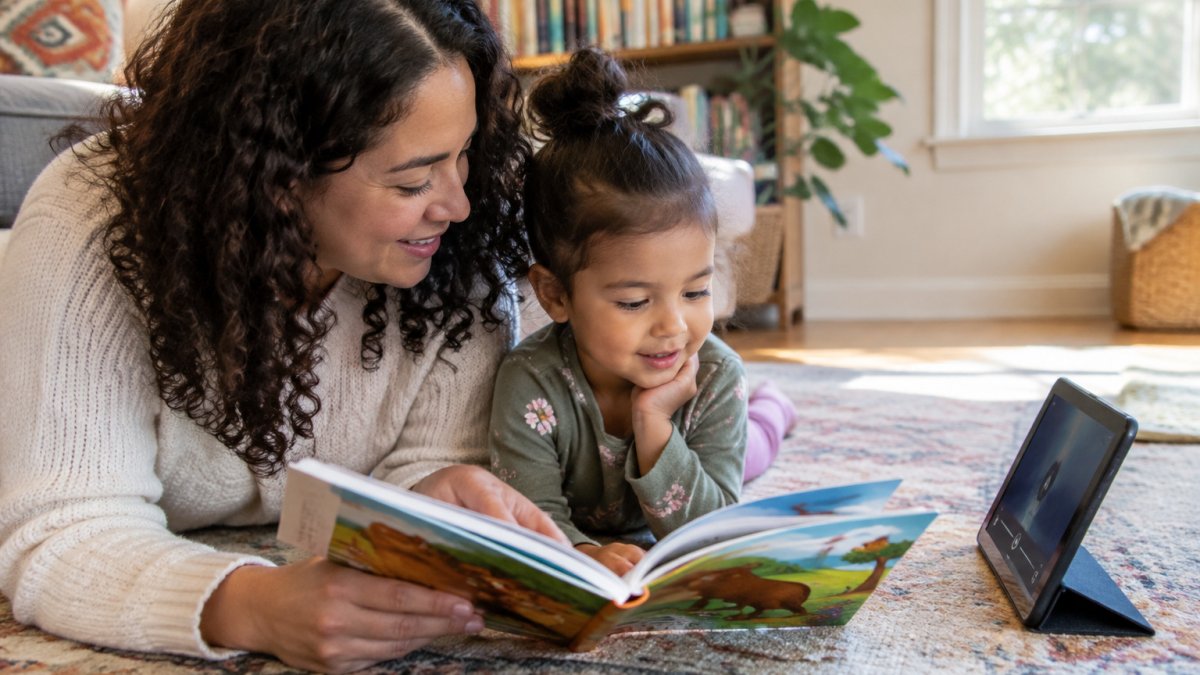
The five-step routine below fits a 5- to 10-minute session, which suits a preschooler's attention span.
| Step | What to do | Time or frequency |
|---|---|---|
| 1. Preview in English | Read the English side aloud and name the pictures | 1-2 minutes |
| 2. Listen together | Play the Spanish audio and follow the pictures | 3-5 minutes |
| 3. Join in on phrases | Replay a page or two and say repeated phrases together | 1-2 minutes |
| 4. Revisit the story | Repeat the same story across several days | 3-5 days |
| 5. Connect to the day | Use glossary words during everyday moments | Ongoing |
Planning Your Child's First Bilingual Reader Set
Start with a set that covers a small, connected group of stories so your child meets the same vocabulary across books. The Bilingual Reader Trio: Bella, Tiago, Ernesto bundles three titles, and includes the e-book, audio read-aloud, and free read-alouds on SpanishGeniuses.com.
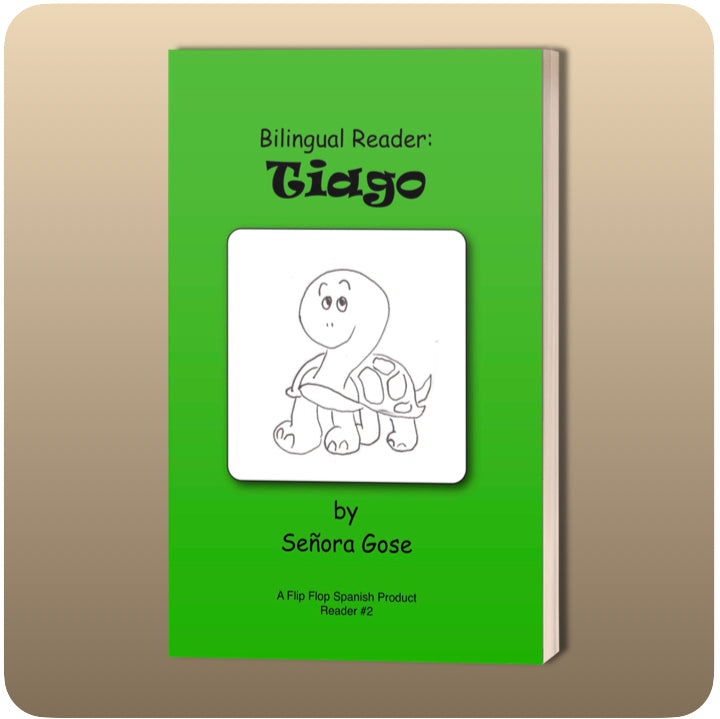
Tiago la tortuga: Bilingual Reader #2 and Ernesto el elefante: Bilingual Reader #3 can be added once your child is comfortable with the first title. Each has an English story on one side and the Spanish version on the flip side, with a glossary in the middle.
Best for: families who want a ready-made set and an easy starting point. Skip if: you only want a single title to test interest.
Plan your first month around one book a week. Listen daily, revisit favorite pages, and add the next title when your child asks for more.
Frequently Asked Questions
Are Spanish audio books suitable for preschoolers who are just starting to learn?
Yes, short bilingual stories with audio suit preschoolers at the start of learning Spanish. The child hears the sounds and rhythm of the language while following simple pictures and familiar words such as colors, numbers and animals. Keep sessions brief, around five to ten minutes, and repeat the same story across several days. Flip Flop Spanish's Bella la cangreja reader, for example, is built around numbers, colors, shapes and weather phrases that a young child can follow with an adult's help.
Can preschoolers learn Spanish by listening to audiobooks?
Preschoolers can build early listening comprehension and familiarity with Spanish sounds through audiobooks, though audio alone rarely produces conversational fluency. Repeated listening to the same book helps children recognize words and phrases. Pairing the audio with the printed page and a parent pointing at pictures gives the best results. Bilingual readers with a Spanish side and an English side let the adult check meaning quickly during reading.
Are there free Spanish children's audio books online?
Free read-along options exist, and Flip Flop Spanish offers a free read-aloud for each of its bilingual readers on SpanishGeniuses.com. Free audio is useful for trying a story before buying a printed or digital copy. Check whether a free listening option is a full story or a short sample, and confirm that the audio matches the text you plan to read.
What should I look for in a Spanish reader with audio for a 3- to 5-year-old?
Look for short stories with large, simple illustrations, a clear audio read-aloud that matches the printed text, and a glossary so you can check words without a Spanish background. Repeated vocabulary and themes such as animals, body parts and transportation help young children learn. Confirm that the format suits your household, whether printable, digital or both. Flip Flop Spanish's Bilingual Reader Trio includes an e-book, audio read-aloud and free read-alouds for Bella, Tiago and Ernesto.
