

Last Updated: November 10, 2026
Quick Summary
The best spanish curriculum for busy families keeps lessons short, requires almost no parent preparation, and works for several ages at once. Flip Flop Spanish Level 1 splits one lesson per week into three sessions of roughly fifteen minutes, with prep limited to laying out cards and pressing play.
- A fifteen-minute lesson completed three times a week beats a forty-five-minute lesson you skip.
- The 10-minute survival plan uses two five-minute exposures plus one five-minute review weekly.
- If you miss a week, repeat the missed lesson rather than doubling up.
- Drop the Wednesday session before the Friday review, which protects retention.
- Level 1 digital set costs $84.97; the third edition full digital set is $94.97.
Table of Contents
- Why Busy Families Need a Different Kind of Spanish Curriculum
- What the Best Spanish Curriculum for Busy Families Gets Right
- A Realistic Weekly Plan for Time-Poor Families
- Free Spanish Curriculum for Busy Families: What You Can Realistically Expect
- Spanish Homeschool Curriculum Free vs Paid: Where the Money Goes
- Choosing a Spanish Curriculum for Kids of Mixed Ages and Levels
- How to Tell If Conversational Spanish Is Actually Sticking
- See Flip Flop Spanish Level 1 for Your Family
- Frequently Asked Questions
Why Busy Families Need a Different Kind of Spanish Curriculum
Most homeschool parents who quit Spanish don't quit because the language is hard. They quit because the curriculum assumes a parent with an hour of prep time and one student at one level. That is not most households.
A spanish curriculum for busy families has to survive real life: a four-year-old who loses focus in ninety seconds, an eight-year-old who wants a challenge, a teenager who needs a transcript line, and a parent who does not speak Spanish.
That is the throughline of this guide: reducing the friction that kills Spanish study, not finding the "most rigorous" program.
What the Best Spanish Curriculum for Busy Families Gets Right
The best Spanish curriculum for busy families does three things well: it keeps lessons short, requires almost no parent preparation, and works for several ages at once. Everything else is decoration on top of those three pillars.
Short lessons and open-and-go prep
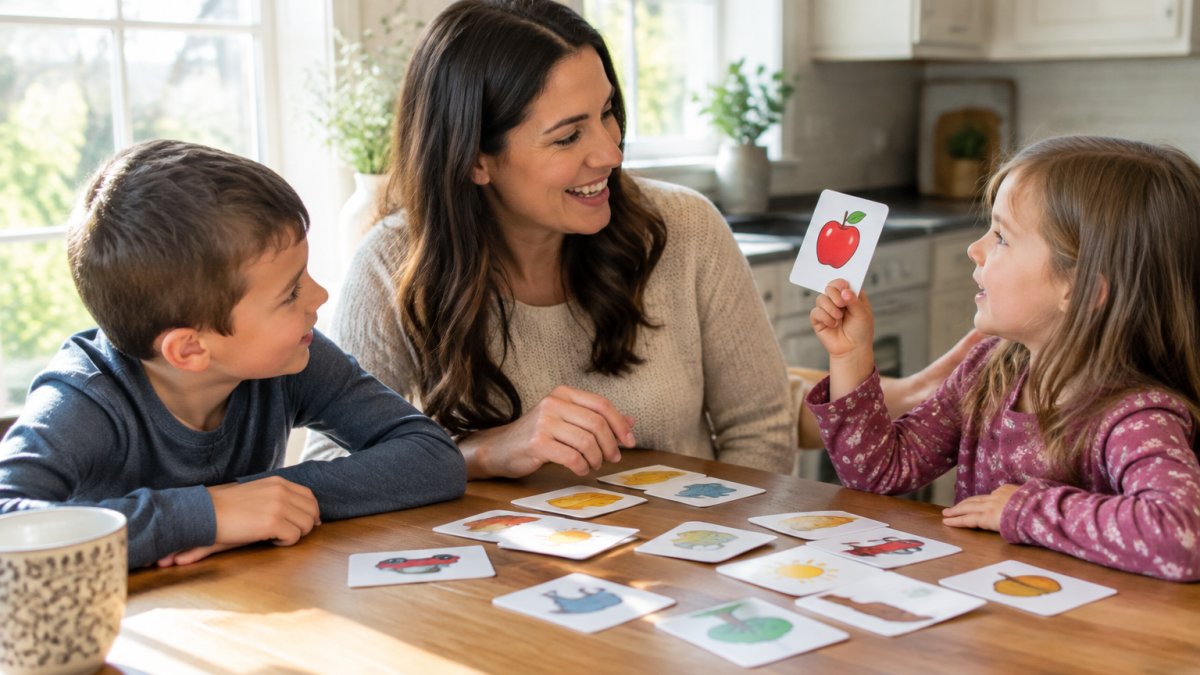
Short beats thorough when consistency is the goal. A fifteen-minute lesson your family actually completes three times a week will outperform a forty-five-minute lesson you skip. Our Level 1 family set is built around one lesson per week split into three sessions of roughly fifteen minutes each, and prep means laying out numbered picture cards and pressing play on the audio track.
Multi-age design and family learning
A common mistake is buying one program per child. Family learning works better, and it costs less. When everyone hears the same vocabulary and plays the same card game, older children naturally model pronunciation for younger ones, and the parent learns alongside them instead of teaching from a script they don't understand.
Charlotte Mason's philosophy of short lessons and living ideas explains why brief, focused sessions suit young learners. It is the methodology behind how we structure every level.
A Realistic Weekly Plan for Time-Poor Families
Most curriculum schedules assume you have the same amount of time every week. Busy families do not. The plan below gives you three versions of the same week so you can pick the one that matches your actual calendar.
The 10-minute version: survival mode
Use this when the week is already full. One new lesson per week, split into two five-minute exposures plus one five-minute review.
| Day | Time | What Happens | Parent Prep |
|---|---|---|---|
| Monday | 5 min | Play the lesson audio once while cards are on the table | 1 min |
| Wednesday | 5 min | Play the same audio again; pause after each word and point to the card | 1 min |
| Friday | 5 min | Say the week's sentence at dinner; no materials | None |
The 20-minute version: the sustainable default
This is a plan a busy household can run through a school year.
| Day | Time | What Happens | Parent Prep |
|---|---|---|---|
| Monday | 20 min | New lesson: lay out cards, press play, follow the audio, repeat each phrase twice | 2 min |
| Wednesday | 20 min | Repeat the same lesson; add the card game or song from the lesson page | 2 min |
| Friday | 20 min | Third listen plus read the lesson page aloud together; oldest child retells one phrase | 3 min |
| Any day | 5 min | Say the week's sentence at dinner or in the car | None |
Time
The 30-minute version: when you have margin
Use this on lighter weeks or when an older child needs more depth. Keep the same lesson but add a production block.
| Day | Time | What Happens | Parent Prep |
|---|---|---|---|
| Monday | 30 min | New lesson plus five minutes of card drill with the oldest child leading | 3 min |
| Wednesday | 30 min | Repeat lesson; younger children do the card game, oldest writes two sentences using the week's vocabulary | 4 min |
| Friday | 30 min | Review plus a short cultural note or story from the lesson page; everyone says one sentence | 5 min |
Low-preparation routines that survive a busy week
Three routines do most of the work in a time-poor household:
- The dinner sentence. One sentence per week, said once at dinner. No materials, no prep, and it builds unprompted production faster than a worksheet.
- The car listen. Play the week's audio track on a school run. This is exposure, not a lesson, so it does not count against your lesson budget.
- The card basket. Keep the current week's cards in a basket on the counter. Any child who picks one up gets a thirty-second exchange. This is the lowest-friction practice in the whole plan.
Missed-week recovery
If you miss a week, do not double up. Repeat the missed lesson and move on.
Watch out: families often treat the Friday review as optional when the week gets tight. The review is the cheapest session to keep and the one that protects retention, so drop the Wednesday session before you drop Friday.
You can put any of these schedules on paper in a minute with our free homeschool chart template.
Free Spanish Curriculum for Busy Families: What You Can Realistically Expect
Free Spanish curriculum for busy families is genuinely useful, but only for specific jobs.
That is not a criticism. It is a budgeting question. A free printable pack can carry you through a season of exploration.
A sensible approach: start with a free sample lesson so you can see the format before you commit. Our free birthday lesson shows exactly what a single session looks like in practice.

Spanish Homeschool Curriculum Free vs Paid: Where the Money Goes
Spanish homeschool curriculum free versus paid comes down to one trade: you either spend money or you spend planning time. The table below is the decision-ready version of that trade.
| Criterion | What free resources typically offer | What a paid family set typically offers | What to check before you buy |
|---|---|---|---|
| Age range | Mixed ages with no placement guidance | A stated family range plus a placement check | Does one purchase cover every child in the house? |
| Lesson time | Single activities of five to fifteen minutes | A weekly lesson split into two or three short sessions | Is the lesson designed for fifteen minutes or padded to forty-five? |
| Teaching support | Printable packs with no parent script | Scripted parent instructions written for non-Spanish speakers | Can a parent with no Spanish background run lesson one without outside help? |
| Format | PDFs, videos, and songs from different sources | One sequence with audio, cards, and lesson pages together | Are audio and pronunciation included, or do you supply them? |
| Speaking practice | Vocabulary exposure, rarely structured production | Scripted speaking prompts and review built into each lesson | Is there a scheduled moment for the child to produce a sentence? |
| Cost | Free per download, but you assemble the sequence | One family purchase for two or more years | What is the cost per child per year once you divide it out? |
| Parent preparation | You choose what comes next each week | Prep is laying out cards and pressing play | How many minutes does the prep column actually take? |
When families ask what they are paying for, here is the honest breakdown of a paid family set:
Our Level 1 digital set runs $84.97, and the third edition full digital set is $94.97 and includes the optional bridge lessons.
A sensible approach for a family still deciding: start with a free sample lesson so you can see the format before you commit. Our free birthday lesson shows exactly what a single session looks like in practice, and a free placement test copy lets you sort each child before spending anything.

Choosing a Spanish Curriculum for Kids of Mixed Ages and Levels
Choosing a Spanish curriculum for kids starts with placement, not price. The mistake is assuming a fourteen-year-old and a four-year-old need completely separate tracks. They need the same vocabulary at different depths.
A practical decision framework:
- If children are within four years of each other, run one family level together and add depth for the oldest
- If a teenager needs high school credit, check whether the program offers a scholar-level track with speaking assessment
- If a child is brand new to Spanish, place them at the start regardless of age
For mixed-age households, a free placement test removes most of the guesswork. Ours is available as a free placement test copy so you can sort each child before spending anything.
How to Tell If Conversational Spanish Is Actually Sticking
Conversational Spanish is sticking when your child produces a full sentence without prompting, not when they can recite a vocabulary list.
Three signals worth watching for:
- Unprompted production. Your child labels something in the kitchen in Spanish without being asked.
- Sentence building. They combine two known words into a new phrase they have not heard before.
- Comprehension in flow. They follow a short spoken instruction without translation.
If you want a low-effort way to build everyday production, a phrase-a-day supplement does more for conversation than another worksheet. Our Phrases That Stick supplement was built for exactly that job.

See Flip Flop Spanish Level 1 for Your Family
The curriculum that survives a busy household is the one that asks the least of you and still gets everyone speaking.
Families choose it because one purchase covers every child, and parents with no Spanish background can run it.
If you have been waiting for a Spanish plan that fits your actual week, this is it. See Flip Flop Spanish Level 1 for your family and start with the first lesson this week.
The hardest part of homeschool Spanish is not the language. It is building a routine that survives a busy Tuesday, and that requires a curriculum designed for the household you actually have.
Frequently Asked Questions
How much time should a busy homeschool family spend on Spanish each day?
Three short sessions of about 15 minutes per week is enough to make steady progress with a well-structured spanish curriculum. Flip Flop Spanish Level 1 is built around one lesson per week with three sessions of roughly 15 minutes each, so a full week of language learning fits into under an hour. Consistency matters more than length: a family that shows up three times a week for 15 minutes will outperform one that does a single 90-minute block and skips the next two weeks.
Can parents teach Spanish at home if they are not fluent?
Yes, and you do not need prior Spanish to run an open-and-go program. With Flip Flop Spanish, prep means finding the numbered picture cards, laying them out, and pressing play on the audio track. The audio leads the lesson while you follow along in the manual, and phonetic spelling is included throughout the materials so you can pronounce words correctly alongside your children.
Are there free Spanish curricula for busy homeschool families?
Free options exist, usually as printables, app-based drills, or short video series, and they work well as supplements. What they rarely provide is a full sequence across multiple years, audio pronunciation guidance, and lesson plans that hold together for several ages at once. A practical approach is to use free resources for extra vocabulary practice and songs, then rely on a structured spanish curriculum for the core progression. Budget for the spine of the program and treat free material as the bonus, not the foundation.
Can one Spanish curriculum really work for a 4-year-old and a 14-year-old at the same time?
It can when the program is designed for family learning rather than a single grade level. Flip Flop Spanish Level 1 is a two-year curriculum built for all ages, using picture cards, games, charades, and skits that younger children join at their own pace while older students build full sentences. The Spanish Fun Activity Calendar is an optional add-on for a child who wants one more word per day. Scholar-level video courses with optional live speaking sessions are available for high school students.
