

Last Updated: October 26, 2026
Quick Summary
To make a family language plan, set concrete goals for each child, write a one-page family language policy naming who speaks which language and when, then map roles for every caregiver and attach Spanish to daily routines like meals and bedtime. Review the plan monthly and fix breakdowns one habit at a time.
- Write goals as things kids can do, like ordering food by next summer.
- A family language policy should fit on one sheet and be kept on the fridge.
- Spread Spanish roles across caregivers so one fluent adult isn't the bottleneck.
- Three 15-minute sessions a week beat a single two-hour weekend lesson.
- Hold a 15-minute review on the first Sunday of each month.
Table of Contents
- Why a Written Family Language Plan Beats Good Intentions
- Step 1: Set Language Goals for Families Before Anything Else
- Step 2: Write Your Family Language Policy in One Page
- Step 3: Map Who Speaks What, When, and With Whom
- Step 4: Build a Spanish Learning Routine for Kids That Fits Real Life
- Step 5: Steal These Family Language Plan Examples
- Step 6: Troubleshoot When the Plan Falls Apart
- Pick Your Spanish Curriculum and Start This Week
- Frequently Asked Questions
Why a Written Family Language Plan Beats Good Intentions
Most families who want to raise bilingual children start with the same warm feeling: we'll speak Spanish at home, it'll happen naturally.
At Flip Flop Spanish, we've worked with homeschooling families juggling toddlers, tweens, and teens in the same room.
Below: seven steps to build that plan, with a one-page policy template, age-specific goals, and fixes for when it falls apart.
Step 1: Set Language Goals for Families Before Anything Else
Language goals for families are the outcomes you want your children to reach, written in plain terms with a rough timeline. Without them, a plan has no direction.
Start with one goal per child, plus one for the household. Keep them concrete:
- By next summer: everyone can order food and greet people in Spanish.
- This school year: the 8-year-old reads a short picture book aloud.
- Long term: the high schooler earns a foreign language credit.
Goals should describe what your kids can do, not what they know.
Write your goals where you'll see them. A sticky note on the fridge beats a document buried in a folder.
Step 2: Write Your Family Language Policy in One Page
A family language policy is a short written statement of who speaks which language, in which situations, and why. It's the single most useful page you'll write, and it should fit on one sheet.
Here's a fill-in template you can copy today:
Our Family Language Policy
- Our home languages are: ________ and ________.
- Our target language is: Spanish.
- Caregivers will speak Spanish during: ________ (meals, bath time, car rides).
- We switch to English when: ________ (safety, homework, big emotions).
- Our reason for this plan: ________.
- We'll review this plan on: ________ (date).
Keep it honest. If you only speak Spanish at breakfast, write that. A policy you can follow beats an ambitious one you abandon by week three.
Parents who feel shaky in Spanish often realize here that they need their own foundation first. A self-study resource like Spanish For Mamá eBook puts phrases on a list-making notepad, so a busy parent practices while writing the grocery list.
Step 3: Map Who Speaks What, When, and With Whom
Next, map your household's languages: list every caregiver and family member, their proficiency, and the role they'll play.
| Person | Languages | Main Role in the Plan |
|---|---|---|
| Parent A | English, some Spanish | Leads daily Spanish lessons |
| Parent B | English only | Runs the bedtime Spanish song |
| Grandparent | Spanish | Weekly conversation partner |
| Older sibling | English, learning Spanish | Reads picture books aloud |
This is where mixed-proficiency families find their balance. A caregiver who speaks no Spanish isn't a blocker, they can own one routine, like a morning greeting or bedtime song, using audio to carry the pronunciation.
A common mistake is assigning all Spanish duty to the one fluent adult. That person becomes the bottleneck, and the plan collapses when they're tired. Spread the roles.
Step 4: Build a Spanish Learning Routine for Kids That Fits Real Life
A Spanish learning routine for kids only works if it survives a busy Tuesday. Attach Spanish to things you already do rather than adding a new block to your day.
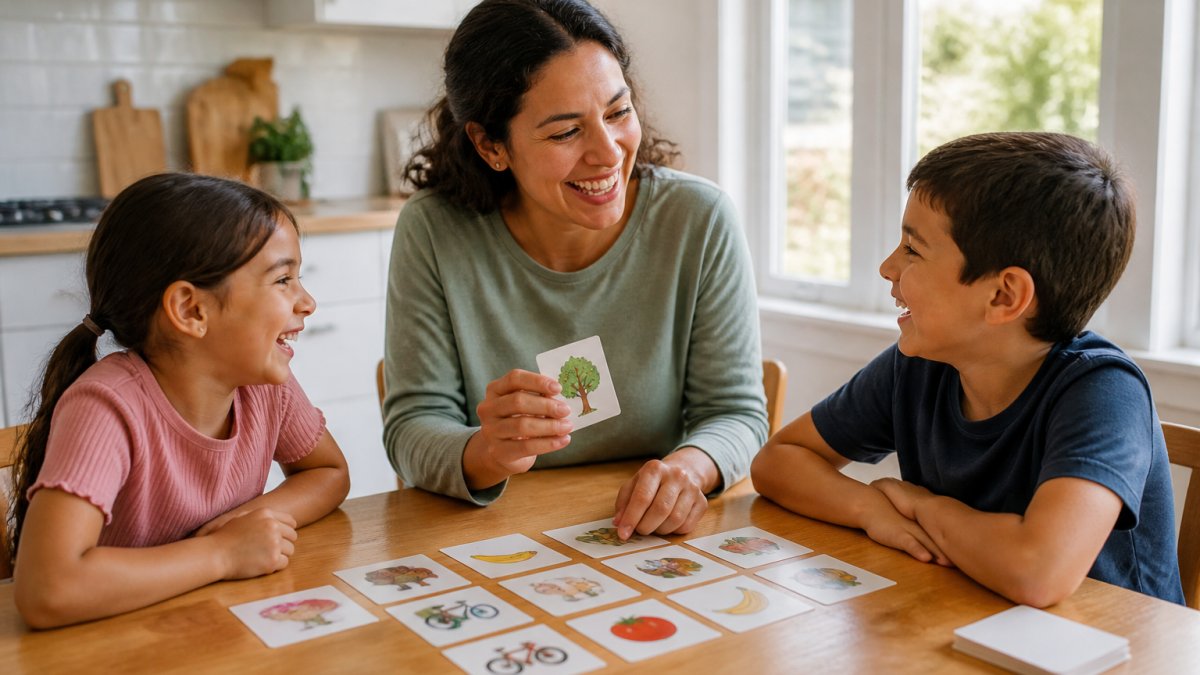
Build your routine around these anchors:
- Meals: name three foods in Spanish at lunch.
- Car rides: play one Spanish audio track.
- Bath time: sing the same short song every night.
Short and daily beats long and rare: three 15-minute sessions a week will outrun a two-hour weekend lesson every time.
If you want the routine pre-built, Spanish Fun Activity Calendars BOTH Levels 1 & 2 Bundle and SAVE! hangs on the wall and adds one practical word per day, with a pronunciation guide and audio included.

Watch out: don't turn the routine into a test. The moment Spanish feels like a quiz, kids start dodging it.
Step 5: Steal These Family Language Plan Examples
Here are three family language plan examples you can adapt, each a complete, fill-in plan with specific times, language assignments, and age-specific goals.
Example 1: The Mixed-Ages Family (Ages 3, 7, and 12)
The most common household we see: one fluent-ish parent, one English-only parent, and children spread across elementary and middle school. The plan uses one shared lesson block but differentiates goals by age.
The one-page plan:
Our Family Language Policy, Mixed Ages
- Home languages: English and Spanish.
- Target language: Spanish.
- Parent A speaks Spanish during: breakfast, bath time, and Saturday morning lesson.
- Parent B speaks Spanish during: bedtime song and car rides.
- We switch to English when: safety, homework help, or a child is upset.
- Reason: we want the kids comfortable speaking with their abuela and confident in a second language.
- Review date: first Sunday of next month.
The weekly routine:
| Day | Activity | Who leads | Time |
|---|---|---|---|
| Monday | Picture-card game at breakfast | Parent A | 10 min |
| Wednesday | Audio-led lesson after school | Parent A | 15 min |
| Friday | Bedtime Spanish picture book | Parent B | 10 min |
| Saturday | Family lesson + skit | Everyone | 20 min |
| Daily | Car-ride audio track | Parent B | 5 min |
Age-specific goals:
- Age 3: understands 20 everyday words (eat, water, dog, up) and responds to simple commands like ven aquí and dame la mano.
- Age 7: reads a short picture book aloud with help and answers three questions about the story.
- Age 12: writes five sentences about the family and holds a two-minute conversation with a grandparent.
Example 2: The No-Spanish Parent Family
One or both caregivers speak no Spanish. The plan doesn't require fluency, it assigns routines that run on audio and repetition so the language lives in more than one place.
The one-page plan:
See it and Say it Flip Flop Spanish: Whole Family Spanish (SiSi) LEVEL 1 →
Our Family Language Policy, Learning Together
- Home languages: English and Spanish.
- Target language: Spanish.
- Parent A (no Spanish) speaks Spanish during: morning greeting and bedtime song, using the audio guide.
- Parent B (some Spanish) speaks Spanish during: dinner conversation and Saturday lesson.
- We switch to English when: a caregiver needs to give instructions or a child is frustrated.
- Reason: we want our children to grow up bilingual even though we're learning alongside them.
- Review date: end of each month.
The weekly routine:
- Morning: Parent A says buenos días and asks one question from a printed phrase card.
- Dinner: Parent B names three foods in Spanish and asks each child one question.
- Bedtime: Parent A plays the same Spanish lullaby every night for a month, then swaps it.
Age-specific goals:
- Preschool: recognizes the sounds of Spanish and joins in on songs.
- Elementary: uses 10 memorized phrases without prompting.
- Teen: completes a short audio lesson independently and reports back one new phrase.
Example 3: The Heritage Language Family
A grandparent or relative is the fluent speaker, nearby or calling weekly. The plan protects that relationship time and pairs it with daily vocabulary so the child has words to use during the call.
The one-page plan:
Our Family Language Policy, Heritage Language
- Home languages: English and Spanish.
- Target language: Spanish.
- Grandparent speaks Spanish during: Sunday video call and monthly in-person visit.
- Parent A speaks Spanish during: daily 10-minute vocabulary practice before the call.
- Parent B speaks Spanish during: bedtime story twice a week.
- We switch to English when: the grandparent needs to discuss something important or the child is overwhelmed.
- Reason: we want our children to know their family's language and culture.
- Review date: after each monthly visit.
The weekly routine:
- Monday-Friday: 10 minutes of vocabulary practice tied to a theme for the upcoming call (food, family, weather).
- Saturday: child draws or writes three questions to ask the grandparent.
- Sunday: 20-minute video call, with the child leading the conversation using the prepared questions.
Age-specific goals:
- Age 4: names five family members in Spanish and answers ¿cómo estás?
- Age 8: tells the grandparent one thing about their week in Spanish.
- Age 14: conducts a 10-minute conversation and writes a short letter in Spanish.
What All Three Examples Share
Notice the pattern: a fixed time, a small lesson, a job for every family member, and a goal written as something the child can do. That structure matters more than which curriculum you pick. Copy the template that fits your household, fill in the blanks, and put it on the fridge.
Step 6: Troubleshoot When the Plan Falls Apart
Plans fall apart. That's normal, and it doesn't mean the plan failed. What separates families who recover from families who quit is having a specific fix ready before the problem hits. Below are the most common breakdowns, with a concrete fix for each.
The Five Most Common Breakdowns
Problem: You've missed two weeks. Fix: Don't restart the whole plan. Pick one anchor, the bedtime song or the car-ride audio, and run only that for seven days. Once that's automatic again, add the second anchor.
Problem: One child resists. Fix: Give them a job instead of a lesson.
Problem: The fluent parent is exhausted. Fix: Hand one routine to another caregiver, using audio to carry the pronunciation.
Problem: It feels like homework. Fix: Swap a lesson for a game, skit, or charades round.
Problem: You can't tell if it's working. Fix: Stop looking for proof in quizzes. Look for it in conversation.
When Caregivers Disagree
Caregiver disagreement is the quiet killer of family language plans. One parent wants more Spanish, the other worries about schoolwork. The fix is to separate the decision from the emotion.
- Write down the disagreement. "We disagree about whether homework should be in English." Naming it makes it solvable.
- Assign languages by situation, not by person. If one caregiver is worried about homework, make homework an English zone and protect Spanish everywhere else. This removes the daily negotiation.
- Give each caregiver a role they chose. A caregiver who picked the bedtime song is far more likely to keep it going than one who was assigned it.
Measuring Progress Without Pressure
Most families either don't measure at all or measure the wrong thing. Vocabulary quizzes create pressure and tell you little about whether a child can use the language. Instead, keep a simple monthly note of what each child can now do:
- Participation: Did they join the activity without being asked?
- Comprehension: Did they respond correctly to a question or command?
- Speaking opportunities: How many times did they speak Spanish this week, even one word?
"Asked and answered three questions about the family" is a real milestone. "Used the word agua at dinner without prompting" is a real milestone. Write these down once a month and you'll see progress that a quiz would miss.
The Monthly Review
Set a recurring 15-minute review, first Sunday of the month works for most families. Bring the one-page policy and the monthly notes. Ask three questions:
- What's working that we should protect?
- What's not working that we should cut or change?
- What's one small thing we'll add this month?
Then update the policy page and put it back on the fridge. A plan that gets reviewed survives; a plan that gets filed away doesn't.
Pick Your Spanish Curriculum and Start This Week
You now have the seven steps: goals, a one-page policy, a household map, a routine, examples to borrow, and fixes for the hard weeks. The last piece is choosing the lessons themselves.
This is where we can help. Flip Flop Spanish builds open-and-go, hands-on, no-screen lessons for the whole family, from Pre-K through high school, using the Charlotte Mason method.
Ready to act? Start with the complete curriculum in the See it and Say it Flip Flop Spanish: Whole Family Spanish (SiSi) LEVEL 1 (3rd Ed.) FULL DIGITAL SET, a two-year-plus program with games, skits, and picture cards that get everyone speaking from day one. If you'd rather compare formats first, the See it and Say it Flip Flop Spanish: Whole Family Spanish (SiSi) LEVEL 1 (Digital Box Set) offers the same family curriculum as a digital box set.


For broader guidance on teaching Spanish at home, the American Council on the Teaching of Foreign Languages publishes language proficiency benchmarks that can help you set realistic goals. And for families weighing bilingual education research, Colorín Colorado's bilingual learner resources offers practical, family-facing information. The U.S. Department of Education also outlines how foreign language study fits into a high school transcript.
Frequently Asked Questions
What should a family language plan include?
A workable family language plan covers four things: the languages your family will use, who speaks each one and when, the goals you have for each child, and the routines that put the language into daily life. Add a short note on how you will track progress and what you will do when the schedule slips. One page is enough. The plan only works if every caregiver can read it and repeat it back to you.
How do you make a family language plan work with a busy schedule?
Keep sessions short and attach them to things you already do. A 15-minute lesson three times a week beats a two-hour weekend block that gets cancelled. Mealtimes, car rides, and bedtime stories are natural anchors. Flip Flop Spanish lessons are built this way: three sessions of about 15 minutes each per week, with prep that means laying out cards and pressing play on the audio track.
How much time should a family spend learning a language each day?
For young children, 10 to 20 minutes of focused exposure daily is plenty, plus whatever conversation happens naturally. Older students aiming for high school credit need more, closer to 30 to 45 minutes several days a week. Consistency matters more than length. A family that does 15 minutes every weekday will outpace one that does an hour twice a month, because language input builds through repetition.
How can parents encourage children to use a heritage language?
Make the language the normal way to do something enjoyable, not an extra task. Play games, sing songs, cook together, and tell stories in the heritage language. Praise attempts rather than correcting every error. If siblings answer in English, restate their answer in the heritage language and move on. Children keep using a language when it gets them something they want: attention, humor, a favorite book, or time with a grandparent.
Your family's language plan doesn't need to be perfect this week. It needs to exist, get used, and get revised. Write the one-page policy tonight, pick one daily anchor, and let the routine do the heavy lifting.
Get started with Flip Flop Spanish and give every child in your home a short, hands-on lesson they can actually stick with.
