

Quick Summary
The best Spanish reading and listening curriculum for homeschoolers depends on your children's ages, your own Spanish level, and your weekly time. Choose an open-and-go program with scripted audio, picture cards, and a clear sequence, so a parent with no Spanish can teach it.
- Pick an open-and-go program with scripted audio so a parent with no Spanish can teach.
- Place children by what they can do, not by the level label on the program.
- Use a four-step listening progression: sound recognition, phrase comprehension, story comprehension, then independent listening.
- Keep listening sessions to ten to fifteen minutes and replay lessons when a child is lost.
- Confirm state and college credit rules before enrolling a high schooler in a Spanish course.
Table of Contents
- What a Homeschool Spanish Reading and Listening Curriculum Should Do
- Matching a Curriculum to Your Children's Ages and Spanish Level
- Self Paced Spanish for Beginners: Open-and-Go Options Compared
- A Reading and Listening Progression for Mixed-Age Families
- Spanish Listening Comprehension Activities for Homeschoolers
- High School Spanish Credit Requirements and How a Homeschool Course Fits
- Planning Your First Weeks and Measuring Progress
- Frequently Asked Questions
How to Choose a Spanish Reading and Listening Curriculum for Homeschoolers
Last Updated: November 15, 2026
Choosing a Spanish reading and listening curriculum for homeschoolers depends on your children's ages, your own Spanish level, and your realistic weekly time. At Flip Flop Spanish, we built our Charlotte Mason-based program for families where a parent may have no Spanish and children range from preschool to high school. This guide covers the decisions that matter most.
What a Homeschool Spanish Reading and Listening Curriculum Should Do
A good homeschool Spanish curriculum does three jobs: it provides comprehensible input through listening, builds early reading skills, and gives the parent a script so teaching doesn't depend on prior Spanish. Many programs cover only one, a pure audio course may leave children unable to read, while a worksheet-heavy textbook may skip the listening that makes words stick.
Before buying, ask whether the program is open-and-go. Some curricula assume the parent can translate on the fly; others provide scripted audio, lesson pages, and picture cards so a parent with no Spanish can run a lesson. That difference determines whether the curriculum is still in use months later.
Look for these basics:
- Lessons that are short enough for young children to stay engaged
- Audio that models correct pronunciation and can be replayed independently
- Reading material that matches what children have heard
- A clear sequence, so each level builds on the last
Matching a Curriculum to Your Children's Ages and Spanish Level
Most families with children of different ages want one program that works for everyone. That is realistic only if the program is built for whole-family learning.
Ages matter because they change what a child can absorb. Preschool and early elementary children learn best through songs, play, and repeated listening. Upper elementary and middle school students can handle reading and simple grammar.
But age is only half the decision; the other half is Spanish proficiency.
A Placement Guide for Three Common Starting Points
Complete beginner (no prior Spanish exposure). Start at the beginning of a whole-family Level 1 program. The child needs listening and speaking first, with reading introduced through picture cards and short sentences.
Heritage speaker or child with home exposure. These children often understand far more than they can read or write, so don't start them at the very beginning by default.
Child with prior classroom or program exposure. Ask what the child actually did in that class.
A practical way to decide is to ask four questions:
- What is the youngest child's age, and will they sit through a short audio lesson?
- Has any child had Spanish exposure at home, in a class, or in another program?
- Does any child need a reading component, or is listening and speaking enough for now?
- Is there a high schooler who needs a formal course or credit?
Matching the Format to the Child, Not Just the Level
Proficiency also affects format. A complete beginner does best with scripted audio and picture cards, so the parent doesn't translate on the fly. A heritage speaker may do better with a reader and audio read-aloud, hearing fluent Spanish while following along in print.
That is why many families run two tracks at once: younger children on the whole-family set, the high schooler on an independent video course. The tracks share a language but not a schedule, keeping costs and lesson prep manageable.
Self Paced Spanish for Beginners: Open-and-Go Options Compared
Self-paced Spanish for beginners works best when the program can be picked up any day without extensive preparation.
When comparing options, look at delivery. Digital downloads let you print and start the same day. Physical boxed sets cost more to ship but can be easier to keep organized.
Here is how our main beginner options compare:
| Product | Format | Price | Best For |
|---|---|---|---|
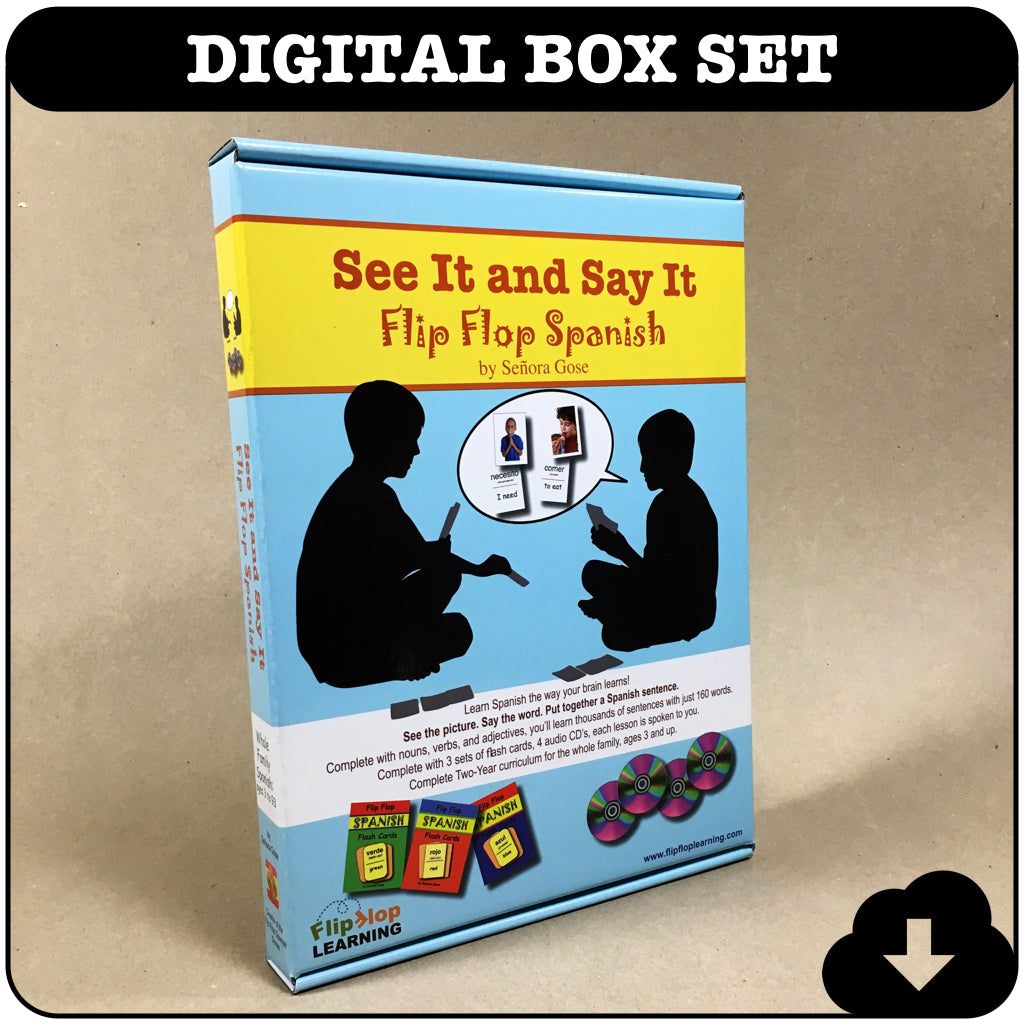
| See it and Say it Flip Flop Spanish: Whole Family Spanish (SiSi) Level 1 (Digital Box Set) | Digital downloads, printable cards, audio | $84.97 | Whole-family beginners wanting a complete first year |
| The Bridge, El puente (ebook and audio) | Ebook and audio | $21.95 | Families finishing Level 1 who want review or gap-filling |
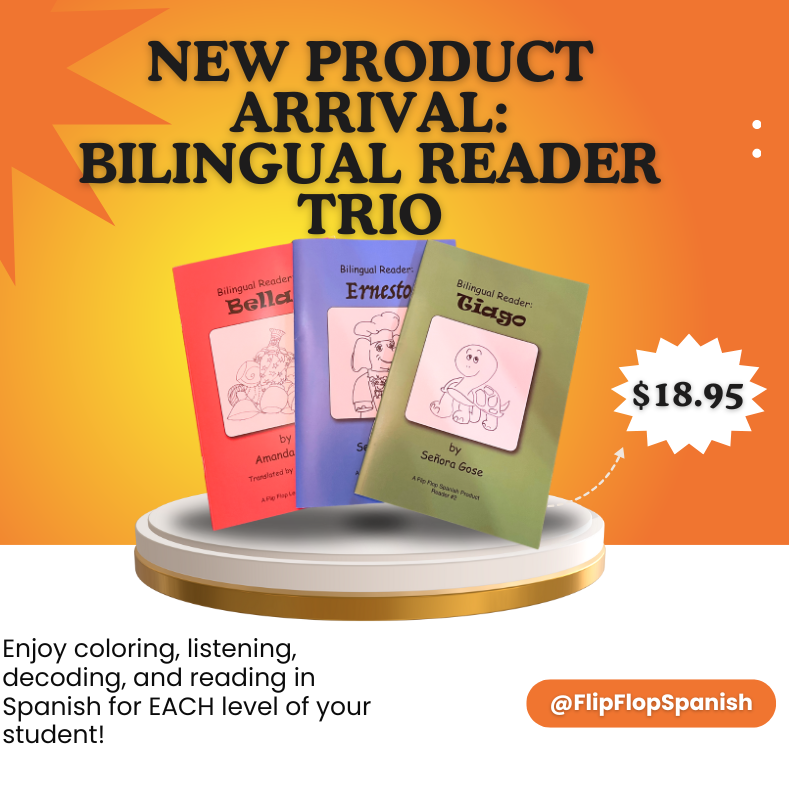
| Bilingual Reader Trio: Bella, Tiago, Ernesto | Books, ebook, audio, read-alouds | $18.95 | Early readers in mixed-age households |
| Flip Flop Spanish Nature Study eBook and Audio | Printable ebook and audio | $15.00 | Families who want Spanish lessons outdoors |
Pros and cons for the Level 1 digital box set:
- Pros: Covers a full first year, requires minimal prep (lay out cards, play the audio), and works for every age in the house.
- Cons: It is a larger upfront purchase, and the audio may feel fast on the first listen, so plan to replay lessons a few times.
Best for: families with children of several ages who are starting from zero Spanish. Skip if: you already have an advanced speaker who needs upper-level grammar from day one.
Product prices in the beginner options table
A Reading and Listening Progression for Mixed-Age Families
A reading and listening progression moves from sound to sight in steps: children first hear words in context, then see them on picture cards, then read them in short sentences, and finally read simple stories.
A workable pattern for one week looks like this:
- Early in the week, everyone listens to the lesson audio together.
- Midweek, lay out the picture cards and practice speaking phrases as a group.
- Later in the week, older children read the lesson text aloud while younger children point to cards.
- End the week with a short read-aloud, such as one of the Bilingual Reader Trio stories, where the English and Spanish sides let children compare meanings.
The Bilingual Reader Trio works well in this progression. Each book has an English story on one side and the same story in Spanish on the other, with a glossary in the middle.
Spanish Listening Comprehension Activities for Homeschoolers
Listening comprehension is where many homeschool programs are weakest, and where children gain the most confidence. The key idea is comprehensible input: children should understand most of what they hear, with a small stretch for new words. Pair listening with movement and response.
What most activity lists miss is sequence. Listening comprehension does not jump from "hear a word" to "understand a story." It moves in steps, and each step needs a different activity.
A Four-Step Listening Progression
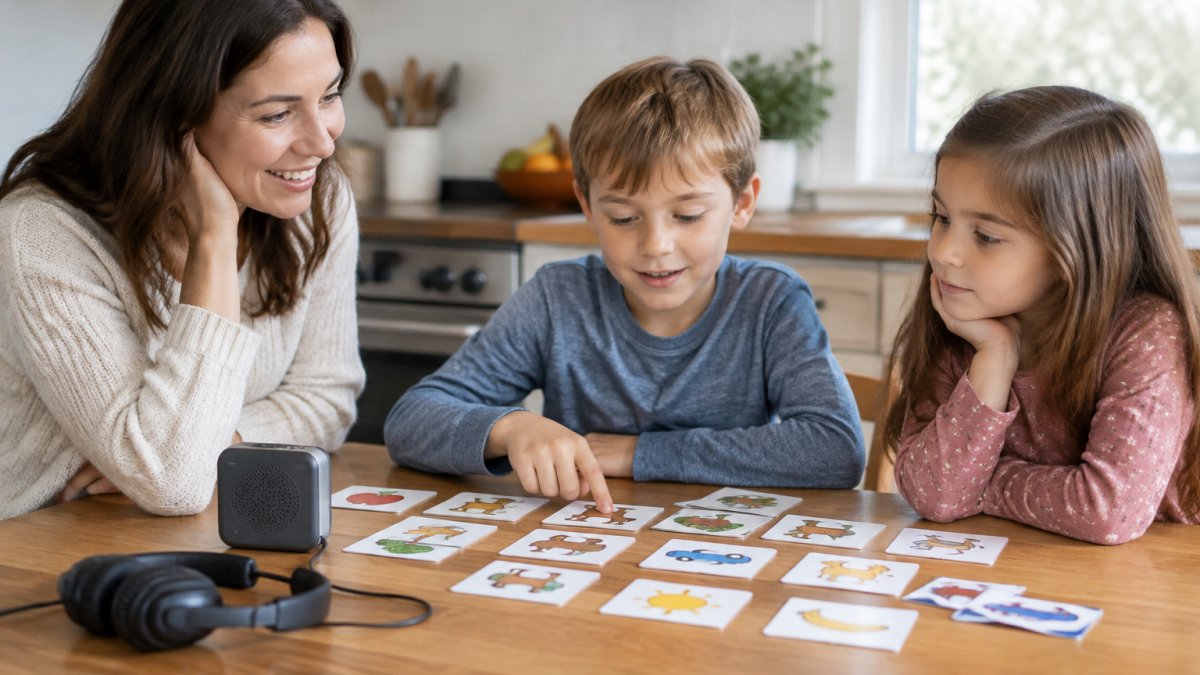
Step 1: Sound recognition. The child hears a word and identifies it. Use listen-and-point with picture cards.
Step 2: Phrase comprehension. The child hears a short phrase and responds with an action.
Step 3: Sentence and story comprehension. The child hears a short story and retells what happened.
Step 4: Independent listening. The child replays audio without the parent and follows along in print.
Keep sessions short. Ten to fifteen minutes of focused listening beats a long session where attention drifts.
Low-Pressure Progress Checks for Listening
You do not need tests to know whether listening is working. A few simple checks tell you more than a quiz:
- Can the child follow a lesson's audio without asking for a replay?
- Can the child point to or name the vocabulary from a lesson after hearing it once?
- Can the child retell two or three events from a short story?
- Does the child respond to everyday phrases outside lesson time, such as a request to sit down or bring a book?
Check these every four to six weeks. If a child is breezing through, move to the next step in the progression or add the Bridge. If a child is consistently lost, return to the previous step, replay audio more often, or slow the pace.
Listening and Learning Differences
Some children need more support with listening, and a curriculum that only offers audio can leave them behind. Children with auditory processing needs do better when listening is paired with a visual or physical anchor, such as a picture card or an action.
Watch out: if a child consistently cannot follow audio that siblings follow easily, do not assume the child is not trying.
High School Spanish Credit Requirements and How a Homeschool Course Fits
High schoolers often need a Spanish credit on a transcript, and that changes what you should choose. Requirements vary by state, school, and college, so check the specific rules your student's school or admissions office uses.
Flip Flop Spanish is designed to fulfill high school speech credit requirements through SpanishGeniuses.com, offering independent, self-paced video courses with optional live weekly speaking and game sessions.
Points to confirm before enrolling:
- Which credit type your state or school counts (speech, world language, or elective)
- How the school wants the course documented, such as a syllabus, a transcript line, or a time log
- Whether live speaking sessions will be part of the requirement
Planning Your First Weeks and Measuring Progress
Your first weeks set the habit that carries the year. Start with two or three lessons per week rather than daily sessions, so the routine feels sustainable.
Measuring progress does not require tests. Some useful signs:
- Can a child follow a lesson's audio without asking for a replay?
- Can a child point to or name the vocabulary from a lesson?
- Can an older child read a short phrase aloud with reasonable pronunciation?
- Are children asking for more Spanish, or repeating phrases during the day?
Review your log every four to six weeks. If a child is breezing through, consider moving up or adding the Bridge. If a child is consistently lost, return to the previous lesson, replay audio more often, or slow the pace. Many families find short, steady weekly practice beats occasional long sessions.
Spanish for a whole family is a long project, and the best curriculum is the one you can keep running. Choose the program that fits your children's ages, your own comfort level, and the time you actually have, and give it a fair trial before deciding it doesn't work.
Frequently Asked Questions
What is the best Spanish curriculum for homeschoolers?
The best choice depends on the ages in your home and whether you already speak Spanish. For families teaching several ages at once, look for a program with a whole-family structure, short lessons and audio support, so older and younger children can share the same material at different depths. Flip Flop Spanish's See it and Say it Level 1 is designed around the Charlotte Mason approach, with short, hands-on, no-screen lessons, and it is built for parents with no prior Spanish. Check each program's age range, lesson length and whether the parent needs to prepare materials each week before you commit.
How many hours a week should a homeschooler spend on Spanish?
Short, regular sessions work better than long ones for most children. In Flip Flop Spanish's Level 1 structure, each weekly lesson includes three sessions of about 15 minutes, which fits easily into a homeschool week. Younger children usually do best with short blocks, while older students can add reading and writing time. Start with a schedule you can keep consistently, then adjust based on how much your children are retaining from listening and speaking practice.
Can a Charlotte Mason approach work for high school Spanish?
Yes, the Charlotte Mason approach emphasizes short lessons, narration, and living language experiences, which can suit older students as well as younger ones. Flip Flop Spanish offers an approach built on this method and states that its program can help fulfill high school speech credit requirements through SpanishGeniuses.com. Confirm with your state, the college or the transcript standard you are targeting that a homeschool course will be accepted, since we cannot guarantee acceptance by any particular institution.
How can I fulfill high school Spanish credit requirements at home?
Start by checking the foreign language credit rules for your state and the colleges your student is considering. Many families document a year-long course with a clear scope, regular practice logs and an assessment of reading and listening skills. A structured curriculum with defined levels makes that documentation easier. Flip Flop Spanish notes that its program can fulfill high school speech credit requirements, so check the specific course details and keep records of completed lessons for your transcript.
